
All The Winners Of Nobel Prize 2017

1.
Nobel Prize in Physiology or Medicine
The 2017 prize was awarded jointly to (L-R)
Jeffrey C. Hall (University of Maine), Michael Rosbash (Brandeis University)
and Michael W. Young (Rockefeller University) "for their discoveries of
molecular mechanisms controlling the circadian rhythm".
The award celebrates the study of the tiny biological clocks in every living thing. The three American scientists “were able to peek inside our biological clock and elucidate its inner workings,” the Nobel Prize Committee said. “Their discoveries explain how plants, animals, and humans adapt their biological rhythm so that it is synchronized with the Earth's revolutions.”
The award celebrates the study of the tiny biological clocks in every living thing. The three American scientists “were able to peek inside our biological clock and elucidate its inner workings,” the Nobel Prize Committee said. “Their discoveries explain how plants, animals, and humans adapt their biological rhythm so that it is synchronized with the Earth's revolutions.”
2. Nobel Prize in Literature

The Literature prize was awarded to Kazuo Ishiguro "who, in
novels of great emotional force, has uncovered the abyss beneath our illusory
sense of connection with the world".
The author of seven novels, a short-story collection and screenplays, Ishiguro was born in bomb-hit Nagasaki in 1954, and moved to England at the age of 5.
The author of seven novels, a short-story collection and screenplays, Ishiguro was born in bomb-hit Nagasaki in 1954, and moved to England at the age of 5.
3. Nobel Prize in Chemistry

The Chemistry prize was awarded to Jacques Dubochet (R), Richard
Henderson (C) and Joachim Frank (L) "for developing cryo-electron
microscopy for the high-resolution structure determination of biomolecules in
solution".
Cryo-electron microscopy is a technique that takes accurate and detailed pictures of living things at atomic scales. This is assisting scientists make high-resolution, 3D images that can help in cancer drug research and better understanding of the Zika virus.
Jacques Dubochet is a retired biophysicist at the University of Lausanne in Switzerland, Joachim Frank, a professor at Columbia University in New York, and Richard Henderson is a scientist at the British Medical Research Council’s Laboratory of Molecular Biology in Cambridge, England.
4. Nobel Prize in Physics
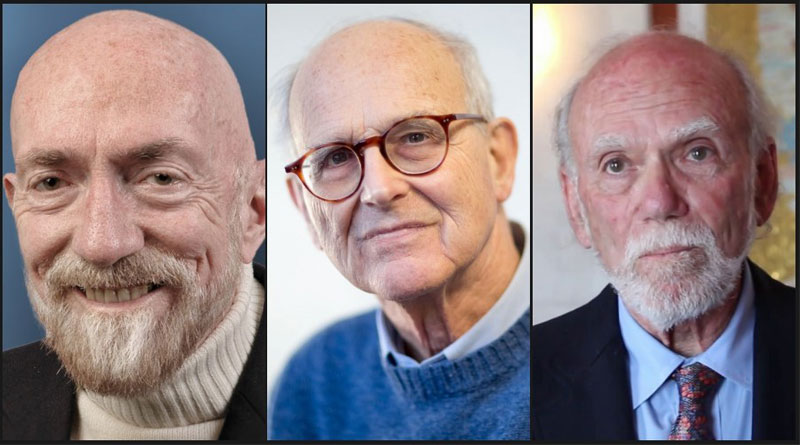
The physics prize was divided, one half awarded to Rainer Weiss
(L), the other half jointly to Barry C. Barish (C) and Kip S. Thorne (R)
"for decisive contributions to the LIGO detector and the observation of
gravitational waves".
They received the prize for the discovery of gravitational waves released in the world by violent events in the universe such as the mergers of black holes. Weiss, professor emeritus of physics at MIT, along with Thorne and Barish, California Institute of Technology physicists, pioneered LIGO, or the Laser Interferometer Gravitational-Wave Observatory, the scientific project that made gravitational wave detection possible.
They received the prize for the discovery of gravitational waves released in the world by violent events in the universe such as the mergers of black holes. Weiss, professor emeritus of physics at MIT, along with Thorne and Barish, California Institute of Technology physicists, pioneered LIGO, or the Laser Interferometer Gravitational-Wave Observatory, the scientific project that made gravitational wave detection possible.
5. Nobel Peace Prize

The Peace Prize 2017 was awarded to International Campaign to
Abolish Nuclear Weapons (ICAN) "for its work to draw attention to the
catastrophic humanitarian consequences of any use of nuclear weapons and for
its ground-breaking efforts to achieve a treaty-based prohibition of such
weapons".
The group formed by Geneva-based coalition of disarmament activists is behind the first treaty to prohibit nuclear arms.
ICAN coordinator Daniel Hogstan, executive director Beatrice Fihn and her husband Will Fihn Ramsay pose after ICAN won the Nobel for its decade-long campaign to rid the world of the atomic bomb as nuclear-fuelled crises swirl over North Korea and Iran.
6. Nobel Prize in Economics

The US economist Richard Thaler was awarded the $1.1 million Nobel
Economics Prize for his contributions in the field of behavioural economics.
The award-giving body said that Thaler's contributions have built a bridge between the economic and psychological analyses of individual decision-making.
The award-giving body said that Thaler's contributions have built a bridge between the economic and psychological analyses of individual decision-making.
Nobel Prize 2017: All The Winners
 Reviewed by Pankaj Yadav
on
October 09, 2017
Rating:
Reviewed by Pankaj Yadav
on
October 09, 2017
Rating:

No comments: